 Leak Detection California
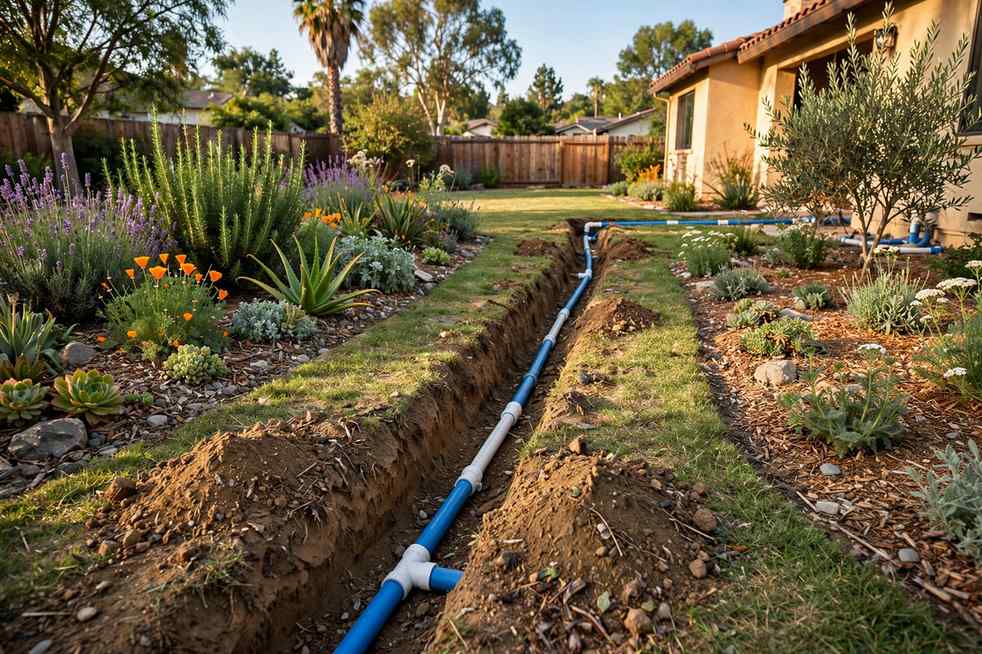
If you suspect an underground pipe leak, look at the yard first, because the ground usually tells the story before the house does. An underground break rarely produces a puddle on the surface at first. Instead it soaks soil, softens a patch of ground, feeds a strip of planting, weakens a sprinkler zone, or drops pressure inside while the house itself looks dry. By the time water surfaces visibly, the break may have been running for weeks. This guide explains the yard signs that point to an underground leak, how to separate a pipe break from irrigation trouble, and how detection narrows a buried line to one section without digging up the whole yard.
How Underground Leaks Behave Differently
Underground pipes live in a world of soil, roots, and movement, and that environment shapes how a leak appears. Water escaping from a buried line does not sit in a neat pool. It moves through soil, follows the path of least resistance, and may surface far from the break, along a trench, under a walkway, or near a foundation. A soggy patch near a fence does not always mean the break is under that fence. The break may sit uphill, under a driveway, or along a utility trench, with water travelling sideways before it appears.
Soil type changes the picture too. Sandy soil lets water drain away quickly, so a leak may show only as unusually lush growth or a soft spot rather than standing water. Clay soil holds water, so a leak may create a boggy patch that stays wet long after rain or watering has stopped. Rocky or compacted soil can channel water along a hard layer and push it out at a distant low point. That is why a yard walk should note the whole pattern, not just the wettest spot: where the ground is soft, where growth looks different, where walkways stay damp, and where pressure changes inside the house.
Roots, ground movement, and age also stress buried lines. Tree roots can press against a line, shift a joint, or enter through a damaged section. Seasonal soil movement can flex a rigid joint over time. Older lines can corrode or scale from the inside, weakening a section until a small break opens. None of these causes can be confirmed by eye alone, which is why underground detection relies on pressure isolation, meter checks, and acoustic listening rather than on digging at the first damp patch. The underground pipe detection service describes that approach, and the guide to how leak detection works explains the sequence of isolating sections before any excavation.
Yard Signs You Should Not Ignore
Walk the yard after a dry spell, when the signs stand out most clearly. Look for ground that stays soft or muddy when the rest of the yard has dried, a patch that sinks slightly underfoot, or a section of walkway, patio, or driveway that stays damp while surrounding surfaces are dry. Look for planting that grows faster, stays greener, or looks lusher in a strip or patch, especially if that strip follows a straight line, since a pipe run often creates a linear pattern of growth. Look for a hose bib that drips when fully closed, a valve box that holds water when the system is off, and a meter box area that stays damp.
Check for sounds as well. With fixtures off and the yard quiet, listen near the meter box, near hose bibs, and along walls where a service line enters the house. A faint hiss or the sound of running water where none should be can indicate a pressurized line losing water underground. Sounds are not proof on their own, since normal system sounds can travel through pipes, but a sound that persists in one place, day after day, is a useful flag to report. Note the location, the time, and whether the sound stops when the main valve is closed, because that detail helps a technician decide which section to test first.
Inside the house, underground leaks often appear indirectly. Pressure may drop, especially when several fixtures run at once. Hot water may arrive unevenly if the break sits on a hot line. A bill may climb gradually, without a change in household habits or watering schedules. A foundation wall may show damp near its base, or a floor near an exterior wall may feel damp or cool in one area. Any of these indoor clues, paired with a yard sign, strengthens the case for an underground check. The article on water bill spikes explains how to separate a rate change from a leak, and the water meter check article shows how to confirm water movement with everything off.
- Ground that stays soft or muddy after dry days, especially along a straight line.
- A strip of planting that grows faster or stays greener than the rest of the yard.
- Walkway, patio, or driveway sections that stay damp while nearby surfaces dry.
- Hose bibs that drip when fully closed, or valve boxes that hold water.
- Pressure that drops when several fixtures run, or a bill that climbs without a habit change.
- A faint hiss or running water sound near a meter box or wall with fixtures off.
Pipe Break Versus Irrigation Trouble
Separating a pipe break from an irrigation problem saves a lot of wasted digging, because the two look similar at first. Irrigation leaks tend to follow watering. A zone that sprays weakly, a head that barely lifts, pooling that appears after a zone runs, or ground that softens only along one zone's run points toward that zone's lateral, valve, or head. A service line or main yard line leak tends to behave independently of watering. It may keep ground soft on days when irrigation has not run, keep a meter moving with irrigation off, or drop indoor pressure even when the yard system is idle.
Test the difference in stages. First, turn off irrigation entirely for a period and watch the yard signs. If soft ground dries, weak heads were the main issue, or damp fades, irrigation is the likely area. If soft ground persists, if a meter test still shows movement with irrigation off, or if pressure stays low, a main line or service line deserves testing. Next, run zones one at a time. A zone that behaves normally while others show trouble points to that zone's components, while a problem that appears across all zones points closer to the main yard line. Note zone numbers and the areas they cover, because that note helps a technician isolate the weak section without testing the whole yard at random.
Pool lines, where a pool is present, add a third possibility. A pool equipment line can leak underground and soak nearby soil, mimicking a yard pipe break. If yard damp sits near pool equipment, if pool water level drops steadily, or if damp appears alongside pool system changes, note that pattern as well. The pool leak signs article explains how to separate pool loss from a plumbing leak, and the outdoor water line detection service covers yard and exterior lines as a group. Passing the full pattern, rather than a single damp patch, lets the technician test house, yard, irrigation, and pool sections in the order that fits what you observed.
The Water Meter Test for Underground Leaks
The meter test is the most practical confirmation step for an underground leak, because it answers a simple question: is water leaving the system when nothing is in use? Turn off every tap, appliance, and irrigation zone, then note the meter reading. Wait, with nothing running, and read it again. If the reading moves, water is going somewhere, and an underground break is a strong candidate when the house shows no indoor sign. If the reading does not move, a supply leak is less likely, though a drain leak or a fixture that only leaks during use can still be present.
For a finer check, a technician can isolate the house from the yard line. Closing the house valve and watching the meter shows whether the loss sits on the house side or the yard side. Closing yard sections in turn narrows the losing section further. That staged isolation is the core of underground detection, because it turns a large buried system into testable parts. Acoustic listening then follows the sound of escaping water along the losing section, and thermal readings can highlight warm areas where a hot line leaks. Together, those steps locate the break closely enough that any excavation that follows targets one area, not a trench across the yard.
Record your meter readings, the times you took them, and whether irrigation was on or off during each test. A note that says the meter moved with irrigation off, that a yard patch stayed soft through dry days, and that indoor pressure dropped when several fixtures ran gives a technician a starting pattern instead of a vague report. Photograph yard signs over time as well, because a sequence of photos can show a patch growing, a strip of growth spreading, or a walkway staying damp through changing weather. Those photos, paired with meter notes, often shorten a visit considerably.
| Yard sign | More likely cause | Test that separates them |
|---|---|---|
| Soft ground only after a zone runs | That irrigation zone | Run zones one at a time, note the weak zone |
| Soft ground with irrigation off for days | Service or main yard line | Meter test with irrigation off, then section isolation |
| Weak heads in one zone only | Zone lateral, valve, or head | Compare zones, check that valve box |
| Low pressure across the whole house | Main line or service line | Meter test, house versus yard isolation |
| Damp near pool equipment | Pool line or yard line nearby | Note pool level changes, test pool section separately |
What Not to Do With a Suspected Underground Leak
Do not dig blindly to find a buried break. Utility lines, roots, irrigation lines, and hard surfaces make blind digging risky, and a trench in the wrong place can damage a sound line while missing the broken one. Mark damp areas with a flag or a photograph, note their locations relative to the house, meter, and known pipe runs, and leave locating to equipment that can hear and trace a line. The same caution applies to heavy equipment or deep digging near a foundation, where a trench can undermine soil support or damage a service line that was previously sound.
Do not ignore a yard sign because it looks small. Underground leaks often start as a slow seep that soaks soil quietly, and the visible patch is only the surface expression of a larger wet area below. Soil erosion under a walkway or driveway can create a void that later causes sinking or cracking, and prolonged damp near a foundation can affect walls and flooring inside. A small soft patch that persists through dry weather deserves the same prompt attention as a visible indoor stain, because the damage underground is happening whether or not water reaches the surface.
Do not turn irrigation up to mask a weak zone, and do not adjust valves repeatedly in the hope that pressure will recover. Increasing watering can hide a weak head while a break continues to run, and repeated valve adjustments can disturb a system that a technician needs to test in its normal state. Keep schedules as they were, note any changes you already made, and let the detection visit work from the pattern you observed. If water is surfacing heavily, if a walkway is sinking, or if a meter test shows rapid movement, shut off the main valve if you can do so safely and arrange help promptly, rather than waiting for the next watering cycle to confirm what you already suspect.
When to Call for Underground Pipe Leak Detection
Call promptly when a yard patch stays soft through dry weather, when a strip of growth follows a line, when a meter test shows movement with irrigation off, or when pressure drops alongside a yard sign. Call sooner if water is surfacing heavily, if a walkway or driveway section is sinking, if a foundation wall shows new damp, or if a meter test shows rapid movement while everything is off. The emergency steps article gives a first-hour plan for active water, and the emergency leak detection service is the route for urgent cases.
Before the visit, gather a short note: yard areas that stayed soft, irrigation zone numbers that behaved oddly, meter readings and times, recent yard work or tree work near pipe runs, and photos showing change over time. Clear access to the meter box, valve boxes, and hose bibs helps the technician test sections in order. If you know roughly where the service line enters the house, note that as well, since the entry point shapes the testing order for house versus yard sections.
If you are seeing these signs on a California property, call Leak Detection California at (833) 382-2711. We will talk through what you have seen, arrange a non-invasive detection visit, and pinpoint the underground break so you can plan one targeted repair with confidence, instead of digging up the yard to search for it.
Frequently Asked Questions
What are early signs of an underground pipe leak?
Look for ground that stays soft after dry days, a strip of planting that grows faster along a line, walkway sections that stay damp, hose bibs that drip when closed, pressure drops, and a bill that climbs without a habit change.How do I separate a pipe break from an irrigation leak?
Turn irrigation off for a period and watch the signs. If soft ground persists or a meter test still shows movement with irrigation off, a main or service line is more likely. If trouble follows one zone only, that zone is the likely area.How does the water meter test help with underground leaks?
Turn off every tap, appliance, and irrigation zone, note the reading, wait, then read it again. If the reading moves while nothing is in use, water is leaving the system somewhere, and a technician can isolate house versus yard sections to narrow it.When should I call for underground pipe leak detection?
Call promptly when a yard patch stays soft through dry weather, when a meter test shows movement with irrigation off, or when pressure drops alongside a yard sign. You can reach Leak Detection California at (833) 382-2711 to arrange a visit.More From the Blog

Water Leak Emergency: What to Do in the First 60 Minutes
Shut off the main valve, make the area safe, protect your belongings, and document damage. A clear first-hour plan for a California water leak emergency.
Read article →
Your Water Bill Spiked: Is It a Leak or Just Higher Rates?
A higher total does not always mean a leak. Compare usage with last year, do a simple meter check, and learn which culprits waste water silently and which are just rates.
Read article →
Why Slab Leaks Are So Common in Southern California
Clay soils, hard water, aging copper, and slab construction combine across Southern California. Here is why slab leaks cluster there and how they are found.
Read article →