 Leak Detection California
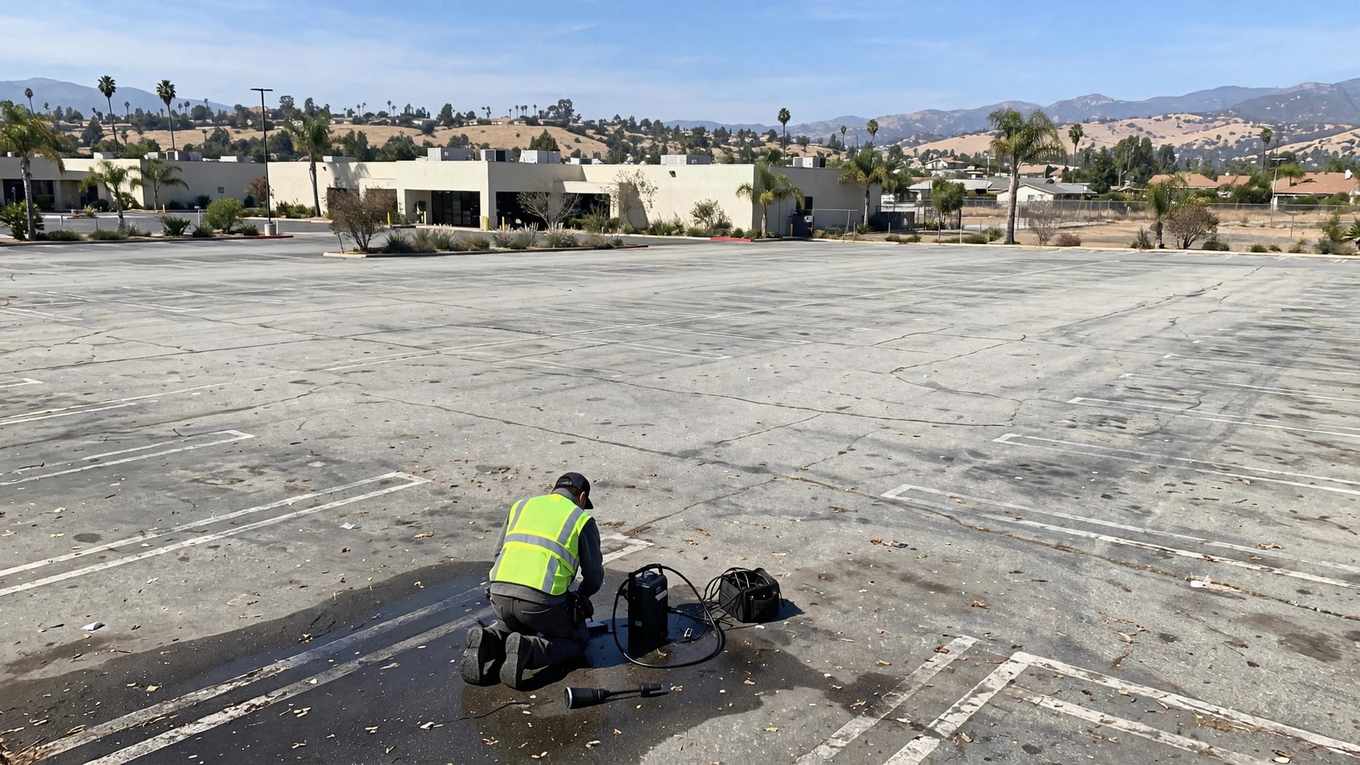
Parking lot leak detection is the location of subsurface water leaks beneath paved commercial lots: the buried water service lines, fire lines, irrigation mains, and storm drainage that run under acres of asphalt. When one of these fails, the surface tells the story in pavement language: a sinkhole opening overnight, asphalt heaving or cracking in a line, standing water that never quite drains, or a section of lot that stays damp long after rain.
Leaks under pavement are uniquely destructive because the water has nowhere to go but into the base material, washing out the compacted foundation the asphalt depends on. We trace buried lines electronically under the pavement, pinpoint the leak with acoustic equipment, and mark the exact saw-cut location so repairs open the smallest possible section of lot. If your pavement is failing and water is the suspect, call (833) 382-2711.
What Runs Beneath a Parking Lot
A commercial lot hides more infrastructure than most owners realize. Each system fails differently:
| Buried system | What it carries | Failure signature on the surface |
|---|---|---|
| Domestic water service | Pressurized potable water to the building | Persistent wet area, hissing, high water bill |
| Fire suppression line | Pressurized water for sprinklers and hydrants | Similar to domestic; often larger diameter, deeper |
| Irrigation main | Pressurized water to landscape zones | Soggy planters, water at lot edges during cycles |
| Storm drainage | Gravity-flow rainwater to outlets | Sinkholes over pipe joints, sediment in catch basins |
| Sanitary sewer lateral | Gravity-flow wastewater | Depressions along the run, odors at drains |
The critical first question is pressurized versus gravity. A pressurized line leak hisses and runs constantly; a storm or sewer failure only moves water during rain or usage, and shows up as settlement and sinkholes instead. Our diagnosis starts by determining which kind of system is failing.
Surface Symptoms That Point Underground
Pavement distress is a language. Here is how to read it:
- Sinkholes or depressions: soil washing into a broken pipe leaves a void; the pavement eventually follows. Always suspect a gravity-line joint failure.
- Linear cracking or heaving: a crack that follows a straight path often traces a pressurized line pushing water up through the base.
- Standing water that never drains: can mean a high water table, but a localized permanent puddle over a line route suggests an active leak feeding it.
- Damp asphalt in dry weather: evaporation should dry pavement within hours. Persistent dampness means a constant water source below.
- Algae or moss on pavement: biological growth needs steady moisture; on a lot that should be dry, it marks a leak-fed zone.
- Unexplained water bills: the building's meter climbing with no interior cause points to the buried service or irrigation main.
Document these symptoms with dated photos. They help us correlate surface distress with the underground route, and they matter for insurance and liability records if the pavement failure affects customers.
How We Work Under Pavement Without Tearing It Up
Detection under asphalt is entirely surface-based until the repair:
- Records review. We gather as-builts, prior repair notes, and your symptom photos to identify candidate lines before we mobilize.
- Pressure and meter testing. For pressurized systems, meter tests and isolation prove which line is losing water. For gravity systems, we inspect catch basins and cleanouts for sediment and flow anomalies.
- Electronic tracing. We trace the suspect line's route beneath the pavement and mark it on the surface, including depth.
- Acoustic pinpointing. Ground microphones and correlation sensors locate the leak along the traced route. Pavement transmits leak noise well, which works in our favor.
- Saw-cut marking. The repair location is marked precisely, typically a small square, so the pavement contractor opens the minimum area and the lot loses the fewest spaces.
For occupied lots, we schedule around business hours and work in sections, keeping the property functional throughout. Most of our time on site is quiet instrument work, not disruption.
Coordinating the Repair With Minimal Disruption
Once the leak is marked, the repair itself needs choreography. We recommend sequencing the work in this order: first, confirm the failed system with our report so the right contractor is engaged, a plumber for pressure lines or an underground contractor for gravity lines. Second, schedule the saw cut and excavation during off-peak hours; most lot repairs need only a few parking spaces coned off for a day. Third, have the paving contractor lined up before excavation starts, so the cut is patched promptly rather than sitting open. Fourth, photograph the exposed pipe before backfill for your records; it documents the failure mode for insurance and future reference. Throughout, keep a simple log of the disruption for tenant communications. A one-day, few-spaces repair beats a week-long saga, and it starts with knowing exactly where to cut.
Protect Your Lot and Your Liability
A failing parking lot is a liability exposure as well as a maintenance problem: trip hazards, vehicle damage, and undermined pavement near buildings. Our licensed and insured specialists locate the subsurface source precisely, document it for your records and insurer, and mark a minimal repair footprint. Same-day appointments are available across California.
- Pressurized and gravity systems both diagnosed
- Electronic tracing under asphalt and concrete
- Minimal saw-cut marking keeps repair disruption low
- Photographic documentation for insurance and liability files
Sinkholes, heaving, or mystery wet pavement? Call (833) 382-2711 now for parking lot leak detection in California.
Leaks Under Asphalt Announce Themselves Late
Asphalt hides leaks well. A pressurized line can lose water under a parking lot for months while the surface looks fine, because the base material spreads the water sideways instead of letting it rise. The first visible signs tend to be secondary: a patch of pavement that stays darker, early cracking in one area, or a section that begins to settle as the base washes out.
By the settlement stage, the leak is no longer small, which is why commercial properties benefit from acting on the meter evidence instead of waiting for the surface to confess. Detection under pavement relies on acoustic correlation along the line's known route, so repairs open one saw cut section rather than trenching a lane.
Parking Lot Leak Detection Across California
We provide this service in every corner of California, a few of the 988 cities we serve.

Related Services
Pair this service with related detection, or see all 15 services.
Ceiling & Wall Leak Detection
Ceiling and wall leak detection is the art of finding water hiding inside your home's structure. A brown stain…
Learn more →
Underground Pipe Leak Detection
Underground pipe leak detection is the tracing, locating, and leak-pinpointing of buried water lines: the deep…
Learn more →Frequently Asked Questions
How do you tell a water line leak from a storm drain failure?
Behavior and instruments. Pressurized line leaks run constantly, hiss acoustically, and move the building's water meter; storm drain failures show settlement and sinkholes with no meter movement and no acoustic signature. We test both hypotheses rather than assuming.
Will finding the leak require cutting the asphalt?
Detection requires no cutting at all: tracing and acoustic work happen on the surface. Only the repair needs a saw cut, and our precise marking keeps it to the smallest square that exposes the break.
Can you work while our business stays open?
Yes. Detection is quiet, surface-based work that we stage in sections to keep traffic flowing. We routinely schedule around peak hours for retail and restaurant properties.
Who is responsible if the leak is under a shared lot?
It depends on easements, leases, and which system is leaking. Our report identifies the failed system and its location precisely, which gives owners, tenants, and HOAs the facts needed to assign responsibility fairly.
How much does parking lot leak detection cost?
It depends on lot size, the number of buried systems, and how much is unknown. Call (833) 382-2711 for an upfront quote.