 Leak Detection California
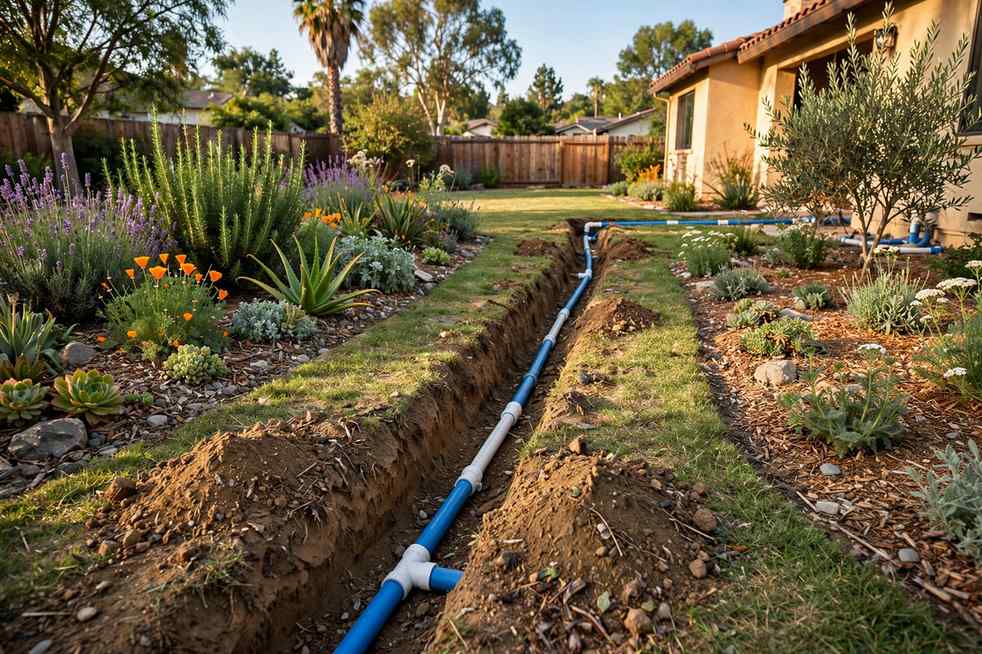
Outdoor water line leak detection covers the potable water lines that distribute water around your yard after the house shutoff: the runs feeding hose bibbs, garden zones, detached garages, guest houses, pool equipment, and outbuildings. These are not irrigation lines, which carry non-pressurized water only during watering cycles. Outdoor water lines are pressurized around the clock, just like the pipes inside your house, which means a break out here behaves like an indoor supply leak, except it drains into soil instead of staining drywall.
Because these lines run underground across the property, the symptoms are subtle: a soggy patch of lawn far from any sprinkler head, one hose bibb with weak pressure while the others run fine, or a water bill that climbs even though the irrigation schedule has not changed. We isolate and pressure-test each outdoor run, then trace the failing line with acoustic listening and electronic locating to mark the break. Call (833) 382-2711 if your yard is telling you something is wrong.
What Counts as an Outdoor Water Line
The distinction matters because each part of your water system is diagnosed differently. Here is where outdoor water lines sit:
| Line type | Location | Pressure | How it leaks |
|---|---|---|---|
| Service line | Street main to the house meter | Constant, high | Soggy strip along the pipe path; utility may own part |
| Indoor supply | Inside walls and under slabs | Constant, high | Stains, sounds, warm spots |
| Outdoor water line | House shutoff to bibbs, outbuildings, garden zones | Constant, high | Wet soil patches, weak individual bibbs |
| Irrigation lateral | Valve to sprinkler heads | Only during watering | Soggy turf, weak zone heads |
Outdoor water lines occupy the middle ground: always pressurized like indoor plumbing, but buried like irrigation. That combination makes them some of the most overlooked leaks on a property, because homeowners check the house and the sprinklers and never think of the line to the back hose bibb.
Signs of a Leaking Outdoor Water Line
Watch for these symptoms anywhere downstream of your house shutoff:
- A persistently wet or sunken patch of soil or lawn nowhere near a sprinkler head
- One hose bibb with noticeably weaker pressure than the others
- A bibb that drips or weeps even when fully closed
- Water bill increases with no change in indoor use or irrigation schedule
- Lush, fast-growing grass in a stripe following an underground path
- Soil erosion or a small sinkhole forming in a bed or lawn area
- Hearing water running at an outbuilding when nothing is in use
- Damp soil around the foundation where a line exits the house
The single-weak-bibb clue is diagnostic gold. When every fixture in the house has full pressure but one outdoor bibb runs weak, the restriction or break is almost certainly in that bibb's dedicated underground run.
How We Isolate and Trace Outdoor Runs
Outdoor lines are found by elimination, then traced with instruments:
- System mapping. We identify every outdoor run: each hose bibb, the line to the garage or guest house, pool equipment feeds, and garden zone supplies.
- Isolation pressure testing. Each run is valved off and pressure-tested independently. The run that will not hold pressure is the leaking one, and this step alone often cuts the search from the whole yard to one line.
- Electronic line tracing. We trace the failing run's underground path so we know exactly where it travels, even if it does not follow the route you would expect.
- Acoustic pinpointing. With the line pressurized, listening equipment follows the traced path and peaks over the break.
- Marking for repair. The break point and the line route are marked, so excavation opens one precise spot instead of a trench across the yard.
Because these lines are pressurized constantly, acoustic methods work beautifully here: unlike irrigation laterals that only speak during watering cycles, an outdoor water line leak hisses around the clock.
Protecting Outdoor Lines Year-Round
A little prevention goes far with buried outdoor runs. Insulate exposed risers and above-ground bibb piping before cold snaps; even in mild California climates, a hard freeze can split an unprotected riser overnight. Know which indoor valve feeds each outdoor run so you can shut a single line in an emergency instead of killing water to the whole house. Mark the routes of buried lines after our tracing visit and keep the map: future landscaping, fence posts, and planting projects all become safer. Avoid planting thirsty trees over known line routes, since roots follow moisture straight to joints. And replace aging galvanized or polybutylene outdoor runs proactively once they start weeping; outdoor pipe rarely fails just once.
Common Failure Points We Find Outdoors
Outdoor runs fail in predictable places:
- Hose bibb connections: the joint where the bibb meets the underground line works loose from years of hose yanking and freeze-thaw movement.
- Shallow burial sections: lines buried too shallow get nicked by shovels, edgers, and aerators.
- Old galvanized or polybutylene runs: aging materials corrode or split, especially at fittings.
- Tree root intrusion: roots seek the moisture at tiny joint seeps and eventually crush or penetrate the pipe.
- Uninsulated risers: the vertical pipe feeding an above-ground bibb is exposed to temperature swings and physical knocks.
During the visit we also flag lines at risk of future failure, so one repair visit can prevent the next. Soggy yard or weak hose pressure? Call (833) 382-2711 now for outdoor water line leak detection in California.
Finding the Wet Spot's Real Source
The wettest patch of ground is a clue, not a conclusion. Water escaping a buried line follows the path of least resistance: along the pipe trench, through old root channels, and down whatever slope the soil gives it. The puddle at the surface can sit several feet from the break, especially in the loose fill soil common in newer California developments.
That is why outdoor line work combines methods. Pressure testing proves the line is losing water. Acoustic listening walks the route the pipe actually takes. Moisture probes check whether the soil wetness peaks at the puddle or somewhere uphill of it. When all three agree on one spot, that is where the shovel goes, and usually only there.
Outdoor Water Line Leak Detection Across California
We provide this service in every corner of California, a few of the 988 cities we serve.
Related Services
Pair this service with related detection, or see all 15 services.
Frequently Asked Questions
How is this different from irrigation leak detection?
Pressure and timing. Outdoor water lines are pressurized 24/7 like indoor plumbing; irrigation laterals only carry water during watering cycles. That changes everything about diagnosis: outdoor lines get pressure isolation and acoustic tracing, while irrigation gets zone-by-zone testing. The symptoms differ too: a leaking outdoor line wets soil constantly, while an irrigation leak only shows around watering times.
Will you have to dig up my whole yard?
No. Detection is non-invasive: we isolate, pressure-test, trace, and listen from the surface. Only the repair requires digging, and because we mark the exact break point, the excavation is a single small hole, not a trench.
Can tree roots really break a water line?
Yes. Roots are drawn to the moisture at microscopic joint seeps, then grow into and around the pipe, eventually cracking fittings or crushing soft pipe. If a wet patch sits near a large tree, roots are high on our suspect list.
My hose bibb drips. Is that a line leak?
A dripping bibb is usually a worn washer or packing in the bibb itself, a simple fixture fix. But if the bibb is fine and the ground below it stays wet, or its pressure is weak, the underground run feeding it is the suspect, and that is where detection comes in.
How much does outdoor water line detection cost?
It depends on how many outdoor runs the property has and how far they travel. Call (833) 382-2711 for an upfront quote.