 Leak Detection California
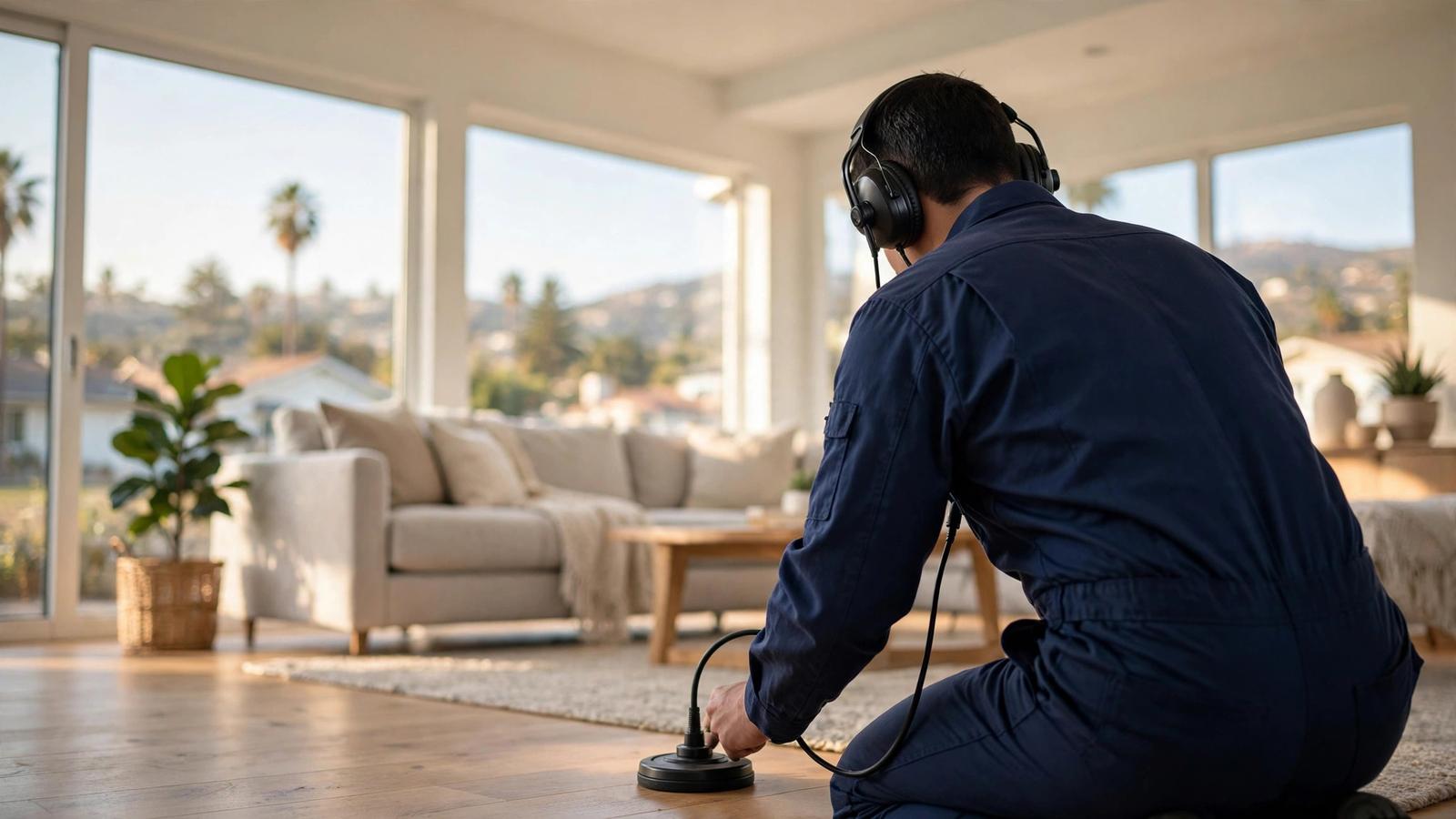
Your water meter is the most honest witness in your home: if every tap is off and the meter is still moving, water is going somewhere it should not. The meter test is the same first check professionals run on arrival, and any homeowner can perform it with no tools in about an hour.
Follow the steps below, learn to read the leak-indicator dial found on most meters, then take the investigation one level deeper by isolating whether the leak sits on your side of the plumbing or the utility's side of the meter. And if the test proves water is moving when it should not be, the next step is a pinpoint survey: our professional leak detection services take it from suspicion to a marked location.
What the Meter Test Can (and Cannot) Tell You
The meter test answers one question with unusual authority: is water flowing through my plumbing right now when nothing should be using it? A moving meter with everything off is near-certain proof of a leak on a pressurized line. A still meter after a proper waiting period strongly suggests your pressurized supply lines are sound at this moment.
What it cannot tell you is where the leak is, only that one exists. It also will not catch drain-line leaks, because drains are not pressurized and do not move the meter, and it can miss intermittent leaks that only flow under certain conditions (a toilet flapper that seals sometimes, an irrigation valve that sticks occasionally). Treat the meter test as the definitive first filter: it tells you whether a hidden pressurized leak is real, and the isolation steps below tell you which half of the system to suspect.
Step-by-Step: The Basic Meter Test
Pick a window of 30 to 60 minutes when no water will be needed. Then:
- Find your water meter. In most California homes it sits in a concrete or plastic box near the curb, sidewalk, or side yard, often marked "water." Lift the lid carefully, meter boxes shelter spiders and insects, and clear any dirt from the meter face so you can read it.
- Shut off everything that uses water. Close all taps. Do not flush toilets, run the dishwasher or washing machine, or start any manual watering. Crucially, switch your irrigation controller to OFF (not just to a non-watering day), and disable automatic features like pool autofill and water-softener regeneration cycles.
- Record the reading. Write down every digit on the odometer-style display, plus the positions of any small sweep dials. Better yet, photograph the meter face with your phone, the timestamp proves when you started.
- Check the leak indicator. Most analog meters have a small triangle, star, or gear, the leak-indicator dial, that spins with even tiny flows. Note whether it is moving; movement now already suggests a leak before the waiting period begins.
- Wait 30 to 60 minutes without using any water. Nobody flushes, nobody washes hands, the ice maker stays off. Longer waits catch slower leaks, so an hour is better than half an hour when you can spare it.
- Re-read the meter. Compare against your photo. Any advance in the digits or sweep dials, even a small one, means water left your plumbing during the test. A completely unchanged reading means no pressurized leak was flowing during that window.
The best time to run this test is when the house will be empty or everyone is asleep, removing the biggest source of error: someone using water mid-test.
Reading the Leak-Indicator Dial
That small triangle or star on an analog meter face exists for exactly this purpose. It is geared to rotate with minuscule flows, far smaller than the main sweep dial registers, so a slowly creeping indicator reveals leaks the odometer digits would need hours to show. If the indicator spins steadily with everything off, you have an active leak. If it twitches occasionally, you may have an intermittent source such as a toilet fill valve cycling. If it sits dead still through the whole waiting period, your pressurized lines are holding.
Digital and smart meters replace the dial with a flow indicator, often a faucet icon, a flashing dot, or a live flow-rate screen. Check your utility's guide for the exact symbol, but the logic is identical: any indicated flow with zero legitimate use means water is escaping somewhere.
Isolating House Side vs Street Side
Once the meter test confirms flow, the next question is where: inside your home's plumbing, or in the underground service line between the meter and the house? Your house main shutoff valve, usually near where the water line enters the home, in a garage, utility closet, or exterior wall box, lets you split the system in two.
With everything still off, close the house main valve completely, then watch the meter (or its leak indicator) for several minutes. If the meter keeps moving, the leak is between the meter and the house, the underground service line, because you have sealed off the entire house and water is still leaving. If the meter stops, the leak is inside: under the slab, inside a wall, at a fixture, or in an irrigation branch fed from inside the house plumbing. Reopen the valve when done.
You can narrow it further. If the leak is inside, try closing the cold-water inlet valve on the water heater: if the meter stops, the hot-water side (often a slab loop) is the culprit. Irrigation zones can be isolated one at a time at the valve manifold. Each isolation halves the search area, the same logic professionals use, just with valves instead of instruments.
What Your Results Mean
Match your outcome to the table below:
| Result | Meaning | Next step |
|---|---|---|
| Meter completely still after a full hour | No pressurized leak was flowing during the test | Monitor; investigate drains, irrigation schedules, or intermittent sources if symptoms persist |
| Leak indicator creeping slowly | A small but real leak on a pressurized line | Schedule a detection visit; try the isolation steps to narrow the zone |
| Meter clearly advancing | An active, significant leak | Call a specialist promptly; consider shutting the house main if the flow is large |
| Flow continues with the house main valve closed | Leak in the underground service line between meter and house | Call for underground line detection; avoid digging blindly |
| Flow stops with the house main valve closed | Leak inside the house plumbing | Check toilets and fixtures first, then call if the source stays hidden |
| Meter still, but the bill is high | Intermittent use, irrigation overwatering, or a past leak already resolved | Audit irrigation programming and toilet flappers; re-test monthly |
Common Meter-Test Mistakes
- Irrigation left on a schedule. The controller waters at dawn while you sleep, invalidating the test. Switch it fully OFF, not just to "rain delay."
- Someone uses water mid-test. One flush or one hand-washing ruins the reading. Test when the house is empty or everyone is asleep.
- Reading the wrong dials. Photograph the whole face so you compare identical dials, mixing up the hundred and thousand dials creates phantom "leaks."
- Too short a waiting period. Fifteen minutes can miss a slow seep. Give it the full hour when the indicator only creeps.
- Forgetting automatic equipment. Pool autofill valves, water softeners in regeneration, and refrigerator ice makers all draw water on their own schedules. Disable or account for each one.
When the Meter Test Says Call a Pro
Call a leak detection specialist when the meter confirms flow and your isolation steps cannot reveal the source, the classic signature of a slab, wall, or underground leak. Call promptly (not eventually) when the meter advances visibly, when the flow persists with the house valve closed (service-line territory), or when meter evidence joins other symptoms like warm floor spots or the sound of running water. Bring your readings and photos to the call: a technician who hears "the meter advanced with everything off, and it kept moving with the house valve closed" arrives already knowing where to start.
Call (833) 382-2711 to describe your meter-test results and get an upfront quote by phone. We serve homes and businesses across California.
Not sure where the leak is? Call (833) 382-2711, same-day appointments available across California.
Frequently Asked Questions
How long should I wait between meter readings?
Thirty to sixty minutes is the standard window, with a full hour preferred. Very slow leaks may need longer to register on the digits, though the leak-indicator dial usually betrays them sooner. For the slowest suspected seeps, an overnight test works, just make sure nothing automatic (irrigation, softener, autofill) will run while you sleep.
My meter is digital with no dials. What do I look for?
Digital meters show flow as an icon, commonly a faucet symbol, a flashing segment, or a live flow-rate readout in gallons per minute. Any non-zero flow with everything in the house off means the same thing as a spinning triangle on an analog meter: water is leaving your plumbing somewhere. Your water utility's website usually documents the exact symbols for your meter model.
The meter didn't move, but my bill is still high. Now what?
A passing meter test rules out a continuous pressurized leak, not every cause of high usage. Check irrigation programming first, overwatering is the most common explanation, then toilet flappers, which can leak intermittently and reseal. Review whether the high bill reflects one month or an ongoing trend, and re-run the meter test monthly. If a high bill persists with no explanation, a professional survey can check what the meter test cannot.
Can I run the test if I can't find my meter?
Yes, with help. Your water utility can tell you the meter's location and will often walk you through the test or send someone to check it with you. The meter box is usually near the property line at the curb or sidewalk. Never force open a box that is paved over or damaged; report it to the utility instead.
Is it safe to shut off my house main valve for the isolation step?
Usually, yes, that valve exists for exactly this purpose. Turn it gently; if it is stuck, corroded, or the handle feels like it might snap, stop and leave it alone rather than forcing it. A plumber can free or replace a seized valve. Never force plumbing hardware, a broken main valve turns a diagnostic step into an emergency.