 Leak Detection California
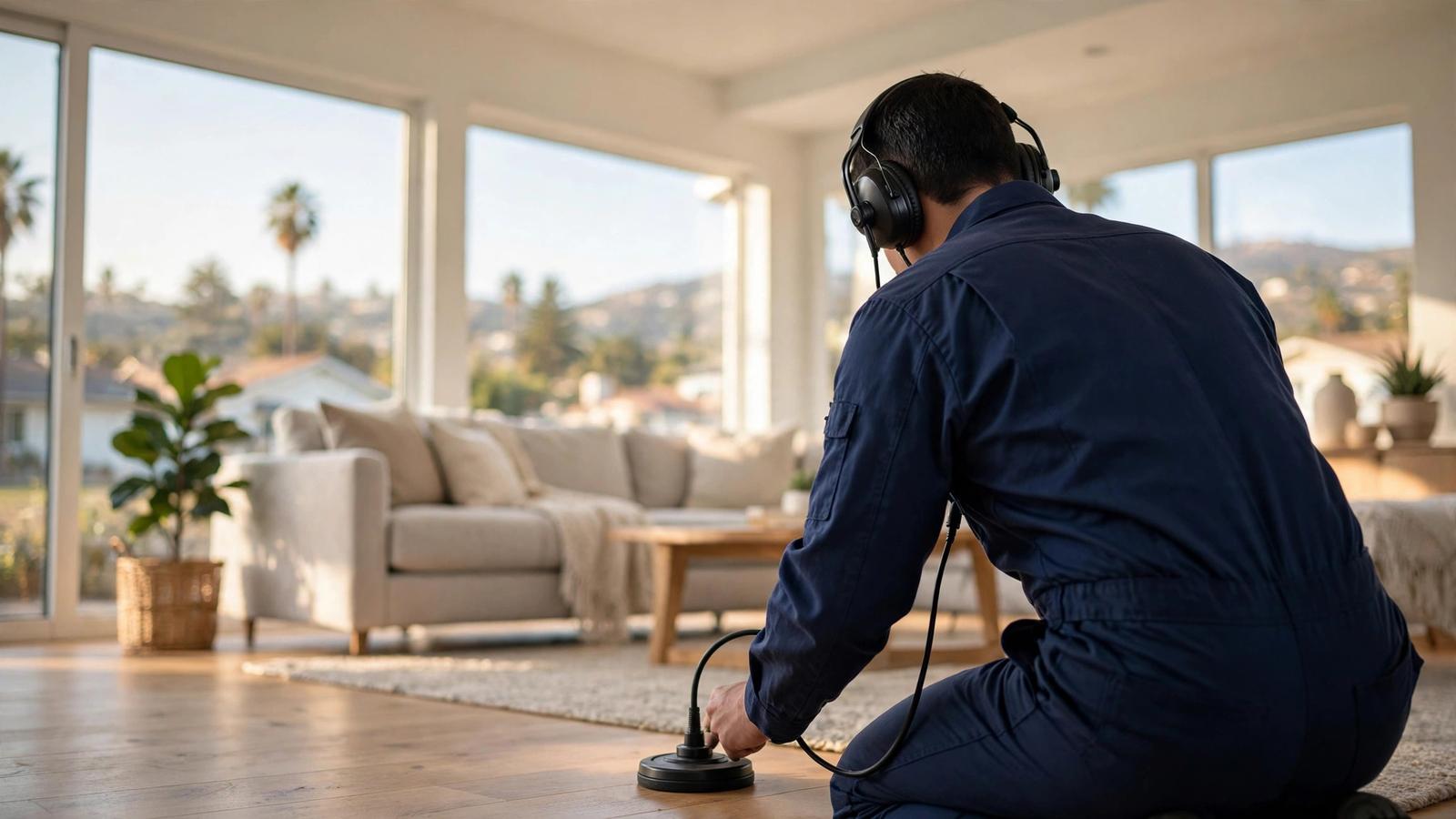
Some leak checks are genuinely do-it-yourself friendly, the water meter test, a toilet dye test, a careful visual inspection, and every homeowner should know them. But DIY has a hard boundary: it can confirm that you have a leak, and sometimes roughly where. It cannot pinpoint a leak inside a wall, beneath a slab, or underground.
This guide compares both approaches honestly: what DIY does well, where it stops, what professional equipment adds, and a clear framework for deciding which one your situation needs. If you land on the professional side of that line, our leak detection services cover everything from slab and pool work to emergency response.
The Fair Comparison
Neither approach is "better" in the abstract, they answer different questions. Here is how they stack up task by task:
| Task | DIY | Professional |
|---|---|---|
| Confirm a leak exists | Water meter test, reliable and free | Meter test plus pressure testing of zones |
| Narrow it to a room or zone | Visual inspection and listening, rough accuracy | Moisture mapping and thermal imaging, precise zones |
| Pinpoint inside a wall or ceiling | Not reliably, stains mislead | Acoustic listening plus thermal cross-check |
| Pinpoint under a concrete slab | Not possible with household means | Acoustic, tracer gas, and line tracing |
| Trace an underground pipe route | Not possible | Electronic line locating equipment |
| Check toilets and fixtures | Dye test, effective and simple | Same checks plus supply-side testing |
| Produce an insurance-ready report | No, homeowner notes only | Written report with photos and readings |
The pattern is clear: DIY excels at detection ("is there a leak?"), while professional work excels at location ("exactly where?"), and location is what controls the cost of everything that follows.
DIY Checks That Actually Work
These homeowner checks are legitimate, effective, and worth doing before you call anyone:
- The water meter test. Shut everything off, record the reading, wait an hour, re-read. Any movement proves a pressurized leak. Our water-meter guide walks through it step by step, including how to isolate the house side from the street side.
- The toilet dye test. Add a few drops of food coloring to the toilet tank, wait 15 to 20 minutes without flushing, then check the bowl. Color in the bowl means the flapper is leaking, one of the most common household water wasters, and a five-minute fix.
- The systematic visual inspection. Under every sink, around the water heater, behind the washing machine, beneath dishwashers, and on ceilings below bathrooms. Look for staining, warping, corrosion on supply lines, and moisture with a tissue test on suspect joints.
- The quiet-house listening check. Late at night, with everything off, listen at walls and floors near plumbing runs. A faint hiss you can localize to one area is genuinely useful information to hand a technician.
- The irrigation audit. Walk each zone while it runs. Geysers from broken heads, perpetually soggy valve boxes, and zones that never seem to shut off properly account for a large share of "mystery" water bills.
- Bill history review. Compare usage month-over-month and year-over-year. A sudden sustained jump marks when the problem started, valuable timeline data for any professional who follows.
The Limits of DIY
Honest DIY advocacy requires naming where it stops. You cannot see through building materials. Water travels along framing, pipes, and barriers, so the stain you find is often feet from the break, opening the wall at the stain is how DIY investigations destroy finishes without finding leaks. You cannot distinguish multiple leaks from one; a meter test confirms flow, not count. You cannot map what you cannot see: buried service lines, under-slab loops, and in-wall routes are invisible without locating equipment, so any digging or demolition based on guessing is a gamble. You cannot produce professional documentation, homeowner notes carry little weight with insurers or in real-estate transactions. And intermittent leaks hide from spot checks: a flapper that seals sometimes or a valve that sticks occasionally will pass a one-hour test and fail you for months.
What Professional Equipment Adds
Professional detection is not "the meter test, but expensive." It is a different capability built on instruments and methodology homeowners do not have:
- Acoustic pinpointing hears the exact point of escape through walls, slabs, and soil, narrowing the location to inches.
- Thermal imaging reveals temperature patterns across surfaces, exposing hot-water slab leaks and cold anomalies invisible to the eye.
- Tracer gas escapes precisely at the break and is detected at the surface, among the most accurate methods for slab and buried lines.
- Line tracing maps the buried pipe route first, so pinpointing instruments are aimed at the right line instead of the wrong one.
- Pressure isolation divides the plumbing into testable sections, identifying the losing zone before the search narrows further.
- Cross-verification discipline: two independent methods must agree before a location is marked. This is methodology, not machinery, and it is why professional findings hold up.
- The written report: photos, readings, marked locations, and repair scope, documentation that serves your plumber, your insurer, and your records.
When DIY Is Enough, and When It Isn't
DIY is enough when the check answers the whole question: the meter test confirms no leak and your bill normalizes; the dye test finds a running toilet you then fix; the visual inspection reveals a dripping supply line you can see and reach; the irrigation audit finds the broken head responsible for the soggy lawn. In each case, detection and location were the same step, you found it because you could see it.
Call a professional when the meter confirms flow but the source stays hidden; when symptoms point under the slab (warm spots, subfloor sounds), inside walls (stains with no visible source), or underground (soggy yard, service-line isolation results); when an insurance claim or real-estate transaction needs documented findings; or when you have already spent a weekend hunting and found nothing. As a rule of thumb: DIY tells you whether; professionals tell you where, and "where" is the answer that controls repair cost, demolition scope, and peace of mind.
The Cost of Guessing Wrong
DIY investigation feels free until a wrong guess sends real money after it. The most common expensive mistake is demolition in the wrong place: opening drywall at the stain, finding dry framing, patching it, then opening another section, each cycle costing finishes, time, and patience while the actual leak keeps running untouched. Misdiagnosis is the quieter version: replacing a toilet flapper and declaring victory while a slab line continues to saturate the soil below, so the "fix" buys nothing and the damage clock keeps ticking. Delayed professional help compounds both, because every week of an active hidden leak expands the eventual repair scope, more saturated material, more mold growth, more structural movement.
None of this means DIY checks are worthless; the meter test and dye test remain the right first moves. It means recognizing the handoff point: once DIY has confirmed a leak but cannot locate it, further guessing has negative expected value. A pinpointed detection visit converts an open-ended hunt into a single targeted repair, and that certainty is what the DIY phase, for all its virtues, cannot produce.
Start With DIY, Finish With Certainty
Run the checks above, they cost nothing and often solve the simple cases outright. But when the leak is confirmed and the location is not, stop guessing and get it pinpointed professionally before anyone opens a wall or a slab.
Call (833) 382-2711 for an upfront quote by phone and non-invasive detection anywhere in California.
Not sure where the leak is? Call (833) 382-2711, same-day appointments available across California.
Frequently Asked Questions
I did the meter test and confirmed a leak. Do I still need a professional?
Only if the source is hidden. If the meter test led you to a running toilet, a dripping faucet, or a visibly broken irrigation head, you have already finished the job, fix it and re-test. But if the meter moves and you cannot find the source by eye, that is exactly the situation professional detection exists for: confirming "where" with equipment rather than demolition.
Can I rent professional detection equipment and do it myself?
Some instruments are rentable, but the instrument is the smaller half of the capability, interpretation is the larger half. Thermal images are famously easy to misread, acoustic signals require trained ears to separate leak noise from ambient plumbing sounds, and tracer gas demands proper procedure. Most homeowners who try this route end up calling a professional anyway, having spent the rental fee to learn its limits.
Will a professional just repeat the same meter test I already did?
They will start there, verifying your finding is standard practice, and then go far beyond it. The meter test is step one of a professional survey, followed by acoustic listening, thermal imaging, moisture mapping, line tracing, or pressure isolation as the symptoms dictate. You are not paying for a repeated test; you are paying for everything that comes after it.
Is DIY documentation enough for an insurance claim?
Generally, no. Insurers evaluate third-party professional evidence, dated reports with photos, readings, and confirmed locations, far more seriously than homeowner notes. If there is any chance of a claim, get the professional detection visit and its written report before repairs begin; it is the documentation the adjuster will ask for.
What's the real risk of just waiting and watching?
Leaks do not heal, and water damage compounds: a small wall leak becomes mold remediation, a slab seep becomes foundation settlement, a yard leak becomes soil erosion. The detection visit is a small, fixed, quoted-in-advance step; the damage it prevents is open-ended and grows daily. Waiting is the most expensive option on the table.